Whooping Crane Observed Near Bruce Station
By Carter Dorscht, Executive Director
This is an exciting one. I’m going to start with the story of the Whooping Crane, then I’ll talk about the significance of the Whooping Crane.
On the evening of April 22nd, I received a message from Brooke Showan saying she saw a Whooping Crane flying with a Sandhill Crane at the edge of Mississauga First Nation and the Town of Blind River. At the time, I was down in London, Ontario at the Ivey Conservation Leadership Program and we were actually out bowling as a group. There have been a handful of sight-only Whooping Crane reports within the past few years, as well as one near Pickford Michigan, so a Whooping Crane being seen isn’t the craziest of ideas. I said something like “neat sighting!” and went back to bowling.
Fast forward to the morning of April 24th, I checked my phone during a break in the program and saw I had a message from Tony Ward with a photo of a Whooping Crane! While sight-only observations should be considered credible due to the easy identification, it suddenly becomes much more real when photos are obtained. If it had been a regular work week for me and I was at our conservation centre in Desbarats, I would have immediately driven the 15 minutes or so it takes to get from there to where Tony had seen it near the intersection of McPhail Road and Highway 638, just north of Bruce Station.
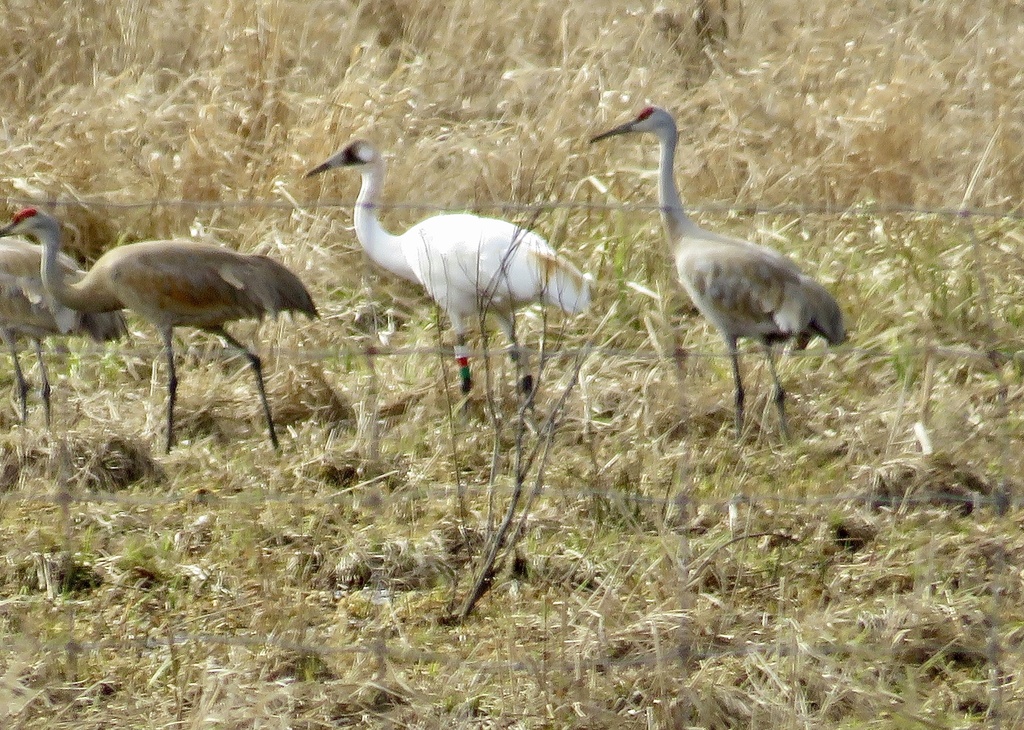
Whooping Crane - Photo by Tony Ward
View on iNaturalist
When Tony last saw it, it had flown south with Sandhill Cranes and he couldn’t relocate it. I helped spread the word to some local birders and the search was on. It wasn’t seen again until that evening when Callum Nixon-Holmes and Steve Holmes found it along Highway 638 in a flooded field. Here’s an excellent video Callum got of it.
Whooping Crane video by Callum Nixon-Holmes
Word had spread to out-of-town birders as well. There had never been a reliable opportunity to see and photograph a Whooping Crane in Ontario. What few sightings there have been have always been chance flyovers never to be seen again. Many birders drove through the night to be on site at first light the following day. Their effort paid off when the crane was still in that flooded field before taking off after about half an hour and disappearing for the rest of the day.
At this point, I was driving back home myself and it was about mid-afternoon when I was passing through Bruce Mines, so I decided to head a little north and take a look myself. I ran into many fellow birders, both locals and out-of-towners, but nobody had any luck. The hope was that it would return to the area at dusk, just like it had the day before. I went home for a few hours, and then returned around 7:30pm with my friends Trent and Chantal Massey. Many people were also there waiting and sure enough, the Whooping Crane eventually showed up for everyone to enjoy.
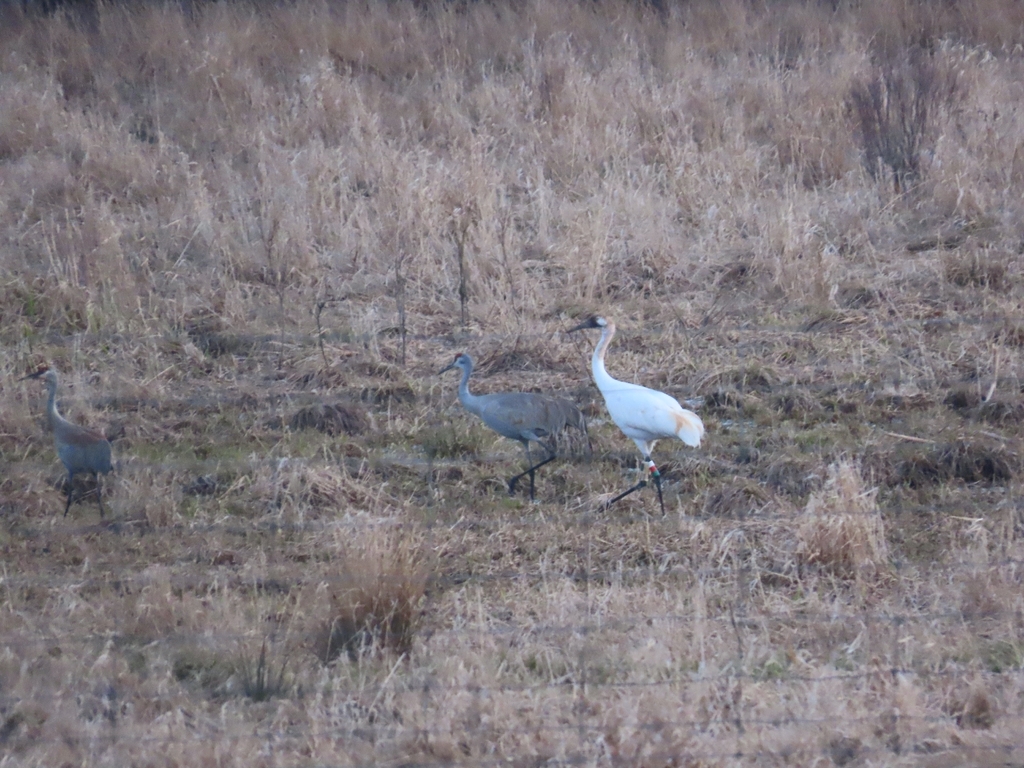
Whooping Crane - Photo by Carter Dorscht
View on iNaturalist
The following day, April 26th, the pattern held true of it being seen first thing in the morning and then last thing in the evening before dark. However, efforts the following two days were unsuccessful, suggesting that it has continued its migration.
Now, for the significance of this Whooping Crane. As you can read in this Nature Notes entry I wrote a couple of months ago, there have been a lot of rare birds seen in the Central Algoma region over the years. Protecting and stewarding habitat locally helps these rare birds thrive when they get off course, but whether that bird survives or not rarely has an impact on the species as a whole.
According to the International Crane Foundation, there are only 834 Whooping Cranes left in the world, 703 of which are in the wild. Thanks to conservation efforts though, this is significantly up from the only 21 that remained in 1941. The population was severely (and continues to be) impacted by habitat loss, sea level rise, low genetic diversity, power line collisions, and poaching. Reintroduction efforts and costume rearing have played a huge role in this recovery.
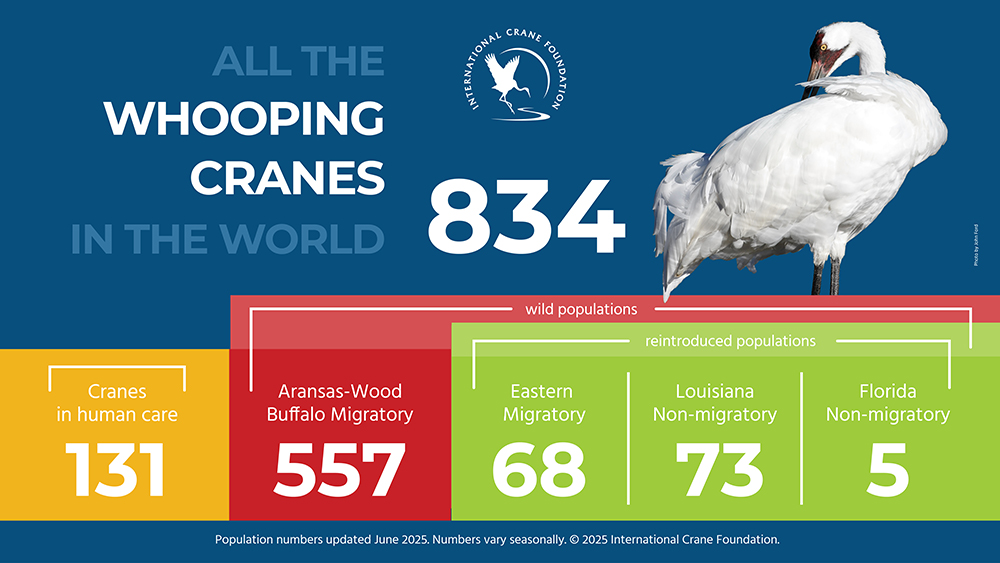
There are two migratory populations of Whooping Crane. A completely natural population still persists, which breeds in Wood Buffalo National Park in Alberta and overwinters in Aransas National Wildlife Refuge in Texas. A reintroduced population breeds in Wisconsin and overwinters in Florida. While these individual birds migrate on their own, they still have human intervention aiding in their success.
This Wisconsin to Florida population is the one that our wayward friend is from. As you may have noticed in the photos and video, there are a number of bands on its left leg and a GPS tracker on its right. These are added to help the International Crane Foundation keep track of these birds.
Tony reported his sighting to the foundation and was able to get some really interesting information about this individual Whooping Crane. It’s identified as 35-25, also known as Sinclair, and was the offspring of wild Whooping Cranes W5-18 and 36-09. She was hatched at the International Crane Foundation and was costume reared before being released at the Horicon National Wildlife Refuge in Wisconsin that fall. She successfully migrated to Florida for the winter and is obviously now on her journey north. You can read more about Sinclair’s story here. As expected, Brooke’s initial sighting near Blind River was indeed confirmed to be the same bird and it will be interesting to learn if Sinclair makes her way back to Wisconsin this spring.
It’s pretty incredible to think that a bird hatched in a facility in Wisconsin and raised by people in crane suits ended up right here in our local fields. While it was extremely exciting for those of us lucky enough to see her, it’s also a good reminder that the work we do to keep our local habitats healthy actually matters. Sinclair’s journey is likely underway again, but her visit shows that Central Algoma is a small but important piece of the map for these endangered birds. I’ll definitely be keeping a closer eye on the Sandhill Crane flocks from now on just in case another white one is hiding in the mix.
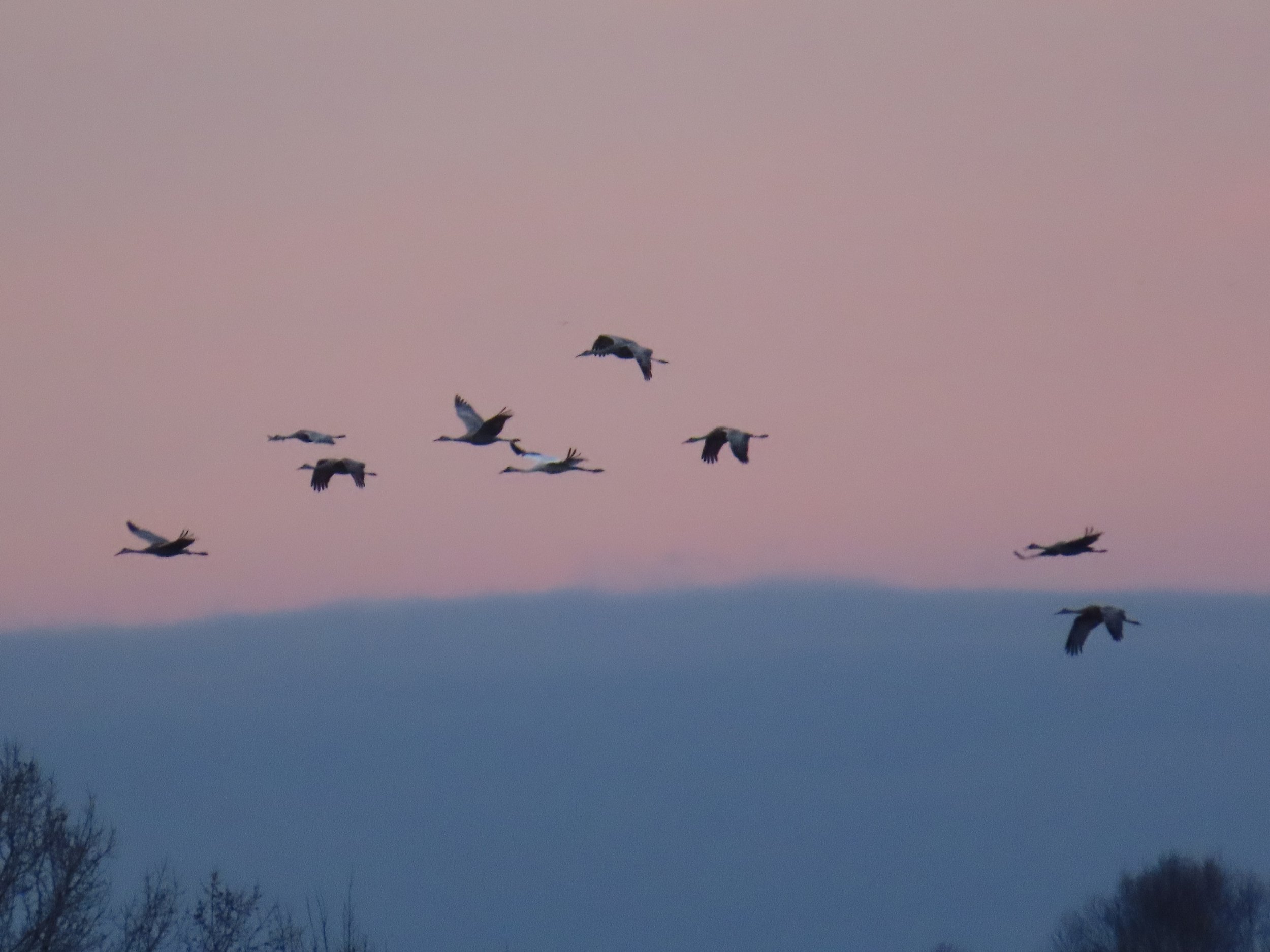
The Central Algoma Land Trust depends on the generous support of our local community to carry out our work. Please consider making a donation to help advance conservation efforts across the Central Algoma region. Your contribution will help protect the natural spaces and wildlife that make this area so special.