
Spring Has Finally Sprung! Watch for the Wildflowers of Central Algoma
Written by Kaitlyn Plastino, Bat Monitoring Technician
After deep snow and a long winter, spring has finally arrived for Central Algoma Land Trust’s protected areas; we are pleased to announce that spring ephemerals are slowly waking up from their long winter naps and beginning to bloom along our hiking trails and monitored properties!
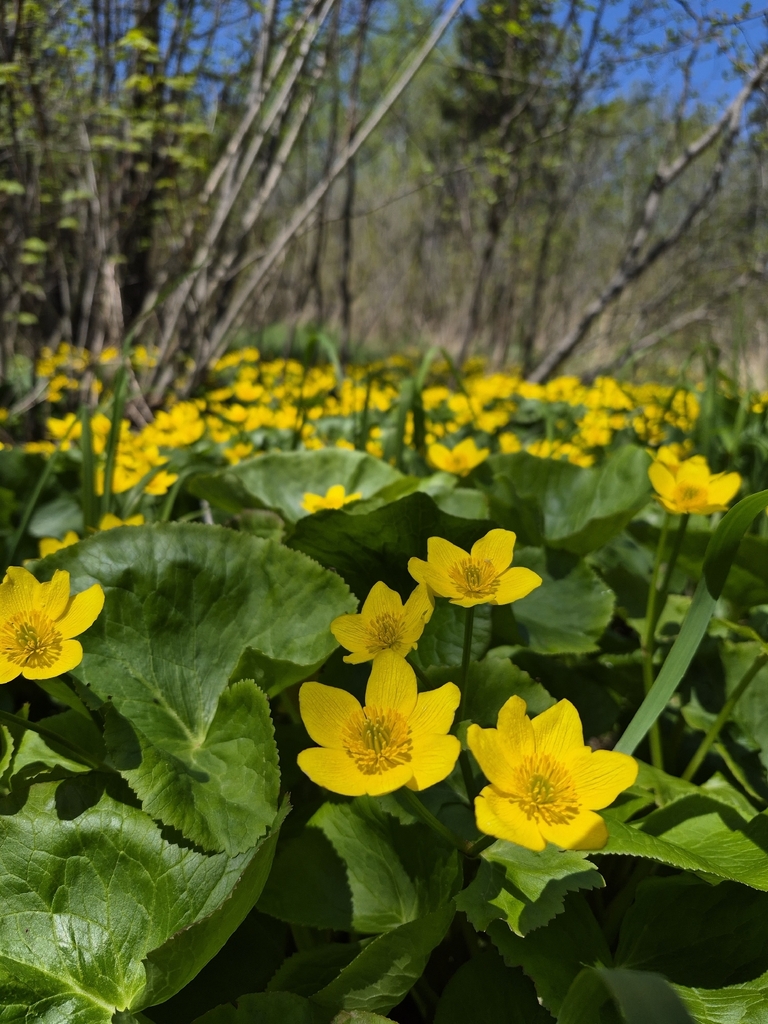
A sea of Marsh Marigolds, a species of spring ephemeral
Spring ephemerals are perennial woodland wildflowers that grow, bloom, and seed all within a few short weeks during the early spring. These fleeting plants complete their entire life cycle before trees leaf out and close the forest canopy, taking advantage of abundant sunlight before dying back and going dormant during the hot summer months. Being the first to bloom, spring ephemerals play an important role in Central Algoma’s forests by acting as a critical food source for emerging pollinators and ants. They also quickly recycle valuable nutrients back to the soil for other plants to use, making their presence a vital phase in the annual spring cycle of the forest.
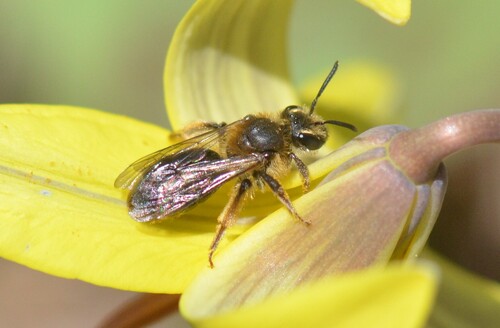
A Mining Bee (Andrena species) visiting a Yellow Trout Lily - Photo by Mark Oliver
View on iNaturalist
Here’s a peek at what’s been blooming, and how you can identify common spring ephemerals while you’re out exploring Central Algoma!
Yellow Trout Lily (Numaegbugoneen; Erythronium americanum)
Yellow Trout Lilies bring vibrant pops of colour to the leaf-strewn forest floor with their bright and recognisable yellow nodding flowers. Living up to their name, trout lilies produce two elliptic green leaves that are mottled brown or maroon, bearing striking similarity to the colouring of a brook trout. Each pair of leaves produces only a single flower which contains six orange-brown stamens that attract pollinators.
A common ground cover in moist deciduous forests, you can find Yellow Trout Lily as a widespread forest floor carpet throughout the Central Algoma region. There are 168 iNaturalist observations of this species in the Central Algoma’, including areas such as the Foster Parkland and Walking Trails; the Ripple Rock, Gravel Point, Black Hole, Stobie Creek, and Phelps Preserves; and the Archibald Homestead.
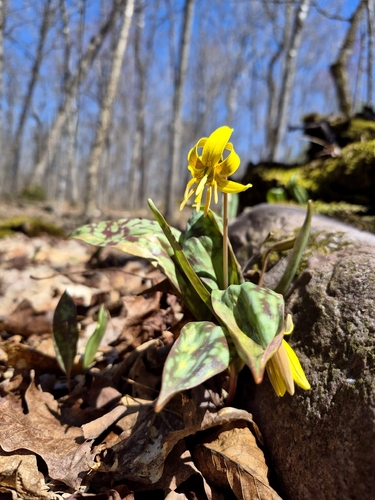
Yellow Trout Lily, Stobie Creek - Photo by Kaitlyn Plastino
View on iNaturalist
Dutchman’s Breeches (Ojidimo miskishmandaumin; Dicentra cucullaria)
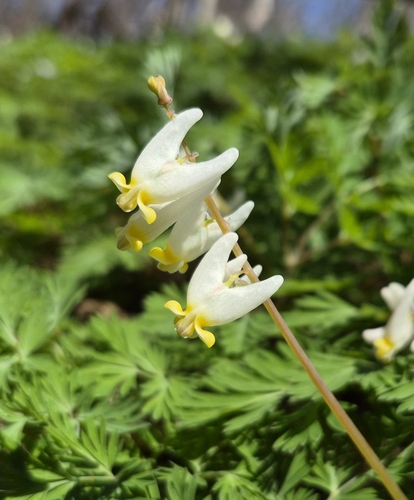
Dutchman’s Breeches are named for this flower’s uncanny appearance to billowing white pantaloons hanging upside down on a clothesline. With feathery, fern-like leaves that resemble carrottops, this plant is easy to spot while exploring Central Algoma. Closely related to another spring ephemeral, Squirrel Corn (Dicentracanadensis), Dutchman’s Breeches can be distinguished from Squirrel Corn by the flower’s pointed ‘pantlegs’ and yellow ‘waistband’.
Dutchman’s Breeches generally prefer well-drained, but moist deciduous forests, allowing them to be observed in CALT protected areas like Stobie Creek. With only 36 iNaturalist observations of Dutchman’s Breeches in CALT’s Focus Area, keep an eye out for this plant on your next walk!
Dutchman's Breeches versus Squirrel Corn
View on iNaturalist
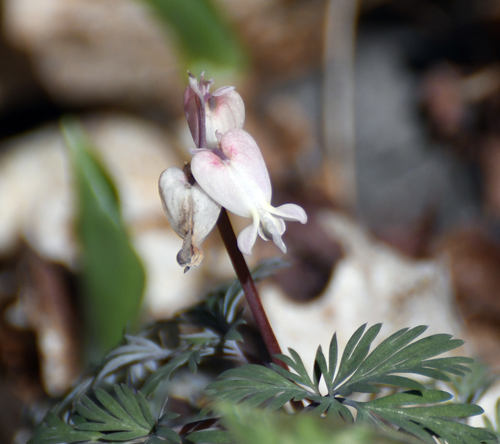
View on iNaturalist
Carolina Springbeauty (Meeautikwaeaugpineeg; Claytonia caroliniana)
The Carolina Springbeauty brings a delicate elegance to the forest understory with their petite and graceful white or pastel-pink flowers streaked with magenta veining. While the magenta streaks are eye-pleasing to us humans, they also serve an important function for pollinators as nectar guides; bright pink landing strips help lead pollinators to the center of Springbeauty flowers, allowing them to pollinate plants more efficiently. Leaves are wide and lance-shaped, distinguishing them from the Virginia Springbeauty (Claytonia virginica) observed in southern Ontario.
Carolina Springbeauties thrive in partially shaded open hardwood forest, speckling CALT preserves like Stobie Creek in an array of white flowers when springbeauties are in bloom. CALT’S Focus Area has 67 iNaturalist observations of this species, including locations like the Phelps, Black Hole, and Stobie Creek Preserves.
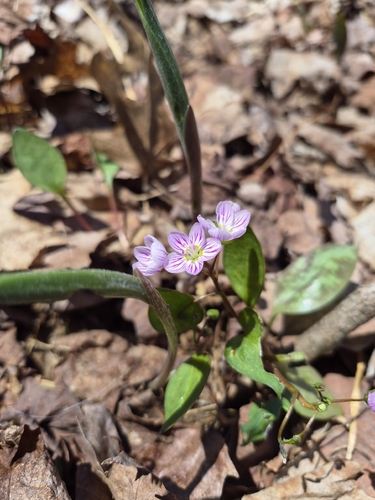
Carolina Springbeauty, Stobie Creek - Photo by Kaitlyn Plastino
View on iNaturalist
Bloodroot (Miskwiiwijiibik; Sanguinaria canadensis)
Bloodroot has a single showy white flower with 8 to 12 elongated petals and a bright yellow center. Its leaves are distinctly shaped with deep lobes and scale-like veining, with a single leaf that gently cups around the stem of the flower when the plant is in bloom. The roots and rhizomes of this plant will bleed a bright red sap when broken, hence the name ‘bloodroot’, and has been traditionally used in natural dyes.
Bloodroot can be found in partially shaded areas at the edge of rich soiled forests throughout Central Algoma. There are 59 observations of Bloodroot within CALT’s Focus Area, most of which are located on St. Joseph Island. You can view observations of this plant on iNaturalist at the Gravel Point Preserve.
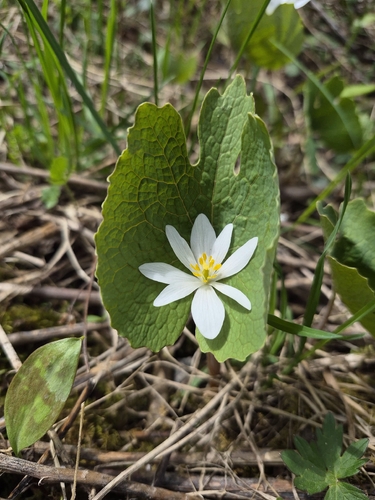
Bloodroot, Gravel Point - Photo by Kaitlyn Plastino
View on iNaturalist
Marsh Marigold - (Ogitebag; Caltha palustris)
Marsh Marigolds have golden star-like flowers with five petals that resemble large buttercups, making them another widely recognisable spring ephemeral. Marsh Marigold leaves are heartshaped and lightly toothed which gives them the appearance of deepveined lilypads.
As a water-loving plant species, you will likely find Marsh Marigolds in wet or low-lying areas such as wetlands, streams, ponds, or even lining ditches - making them a common sight on CALT preserves and throughout the Central Algoma region, with 98 iNaturalist observations within CALT’s Focus Area. See Marsh Marigolds for yourself while hiking the Gravel Point trail along the wetland section!
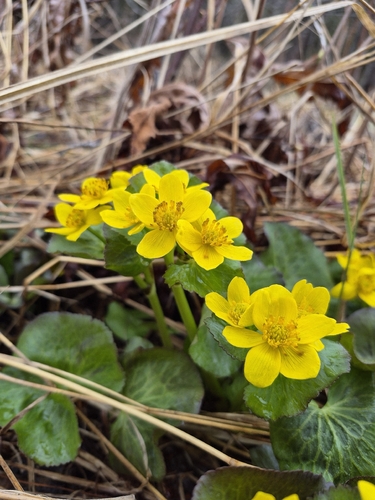
Marsh Marigold, Ripple Rock - Photo by Kaitlyn Plastino
View on iNaturalist
Fun Fact: While many plants often spread vegetatively through rhizomes, the seeds of spring ephemerals are largely dispersed through a special relationship with ants called Myrmecochory. When seeds develop, plants purposefully attach a fatty appendage to each of their seeds called an “elaiosome” which serves as an attractive and delicious snack for ants. Ants will carry entire seeds back to their nest to eat the elaiosomes, but will discard the leftover seeds into their wastepiles once they’re done eating. These wastepiles provide a nutrient-rich space for these seeds to grow, allowing spring ephemerals to spread across vast distances. Next time you see any of these spring ephemerals, you may have ants to thank!
Have you spotted any wildflowers while exploring the Central Algoma region? Come by the CALT office and let us know, or share your photos online with the community science app ‘iNaturalist’. After a long winter, we’re sure glad to have these beautiful flowers waking up to greet us!
Terms
Spring ephemerals: Plants that bloom and complete their entire lifecycle in early spring.
Stamen: An elongated pollen-producing stock located at the center of the flower.
Nectar guides: Patterns on flower petals that help lead pollinators to the center of the flower.
Rhizome: A special plant stem that grows belowground, sprouting roots and shoots that allow a plant to spread vegetatively.
Myrmecochory: When plants rely on ants to disperse their seeds.
The Central Algoma Land Trust depends on the generous support of our local community to carry out our work. Please consider making a donation to help advance conservation efforts across the Central Algoma region. Your contribution will help protect the natural spaces and wildlife that make this area so special.
