
Meet the Hidden Herptiles of Central Algoma
Written by Jazmin Gall, Field Technician
Before we dive into the lesser known herptiles of Central Algoma, let’s start by answering the question: what exactly is a herptile?
“Herptiles”, or the more commonly used (and admittedly quirky) shorthand “herps”, are the terms biologists, conservationists, and naturalists use to describe reptiles and amphibians as a group. The field of study dedicated to them is called herpetology. All of these terms trace back to the Greek word herpetón, meaning “creeping animal” or “crawling thing.”
Unfortunately, that origin doesn’t do much to help their reputation. Snakes are often labeled as aggressive, and dangerous, while toads are still unfairly blamed for causing warts. In reality, these ideas are nothing more than persistent myths. Despite being misunderstood, and often feared, herptiles play just as vital a role in our ecosystems as the mammals and birds we tend to admire.
Reptiles are excellent pest controllers: snakes help keep rodent populations in check, while turtles act as natural cleanup crews, scavenging along shorelines and maintaining healthy waterways. Amphibians, on the other hand, are powerful environmental indicators. Because they have permeable skin and can breathe through it, they are highly sensitive to changes in their surroundings. When amphibian populations decline, it’s often an early warning sign that something in the ecosystem is out of balance.
Across the globe, herptiles are in trouble. Roughly one in three amphibian species and one in four reptile species are now at risk of extinction.
Here in Ontario, we have 47 native herp species: 15 snakes, 8 turtles, 1 lizard, 11 salamanders, 10 frogs, and 2 toads. Alarmingly, nearly half of these species are considered at risk at the provincial level, and more than half are listed federally.
Habitat loss and fragmentation remain the biggest threats they face, but road mortality, poaching, and intentional persecution are not far behind.
In the Central Algoma region, familiar species like garter snakes, painted turtles, and northern leopard frogs are commonly spotted. But something interesting is happening, we are starting to hear about more observations of some of the less popular herptiles of our region.
The question is whether this reflects species expanding their ranges northward due to a warming climate, or simply an increase in interest and reporting of the natural world. As the impacts of climate change become more pronounced, and with easier access to technology and apps such as iNaturalist, Merlin, and eBird, it is likely that both factors play a role, depending on the species.
Below, you’ll find some of the fascinating species that have recently begun to appear on our radar within our new focus area, and that we hope start to become well known regulars of the Central Algoma landscape.
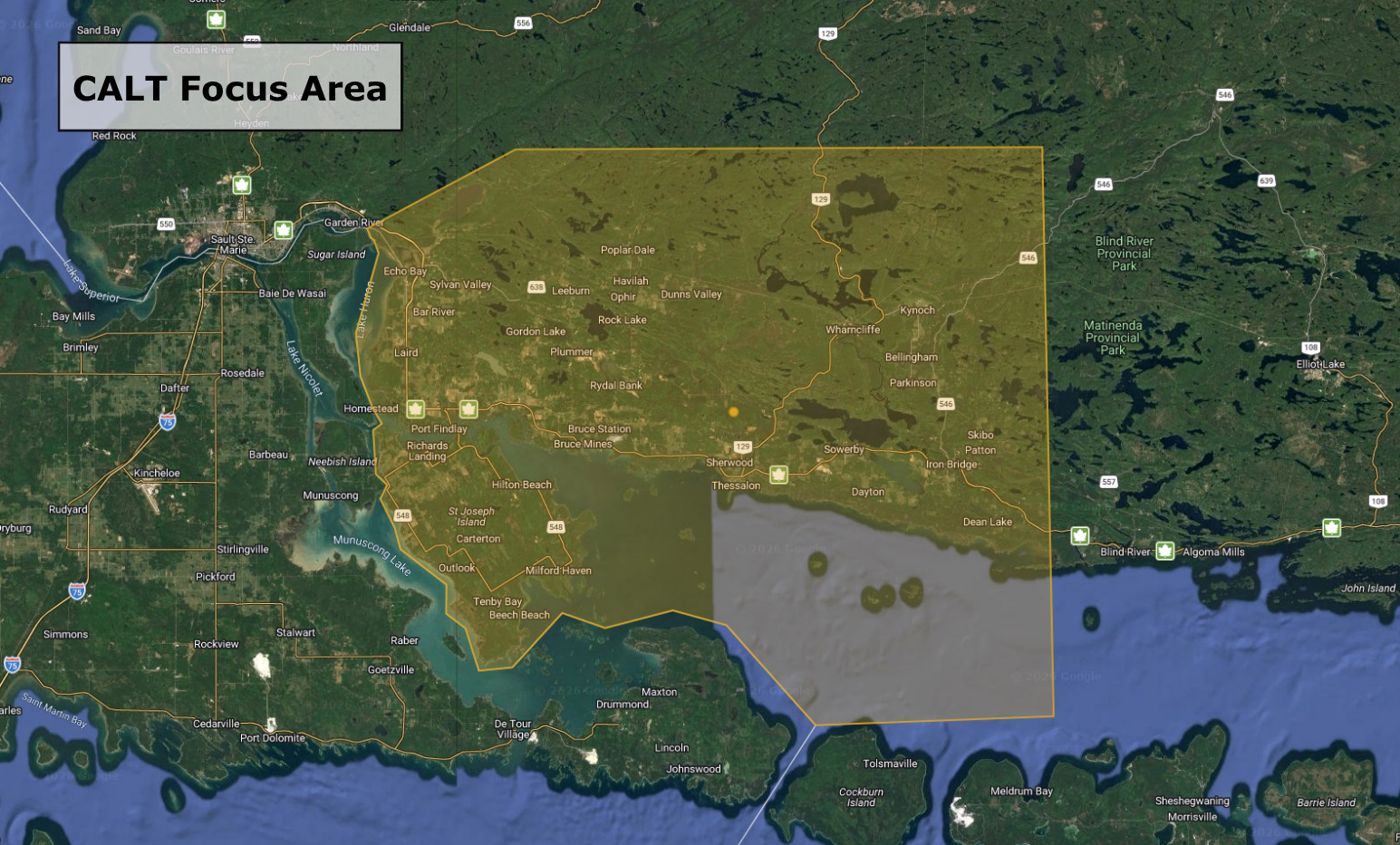
Central Algoma Land Trust’s recently expanded focus area of the Central Algoma region. While our primary focus is within Central Algoma, our conservation efforts remain flexible to respond to the needs of the land, water, and wildlife across the broader Algoma District landscape.
Common Watersnake - 19 observations on iNaturalist in Central Algoma
The Common Watersnake is one of Ontario’s larger snakes, typically reaching 2-3 feet in length. Despite their size, they can be quite easy to overlook as they glide quietly through the water or bask along shorelines, blending in with their surroundings.
In Central Algoma, this species sits at the northern edge of its range. As summers warm and winters become milder, local waterways may be becoming more suitable, which would allow Watersnakes to expand farther north.
However, half of the nineteen iNaturalist observations of Watersnakes have been recorded in just the past two years. This suggests that the pattern may not reflect rapid range expansion, as population shifts typically take years to occur, establish, and grow. Instead, it may point to increased observation and reporting, as more people document wildlife and contribute to community science platforms. This may be less exciting to some but this is a huge win for science and conservation!
Quick ID: Usually brown, grey, or reddish with dark bands or blotches. As they age, their pattern can fade, making older individuals appear almost uniformly dark, sometimes leading to misidentification.
Fun Fact: They’re one of the few snake species in Ontario that give birth to live young instead of laying eggs.
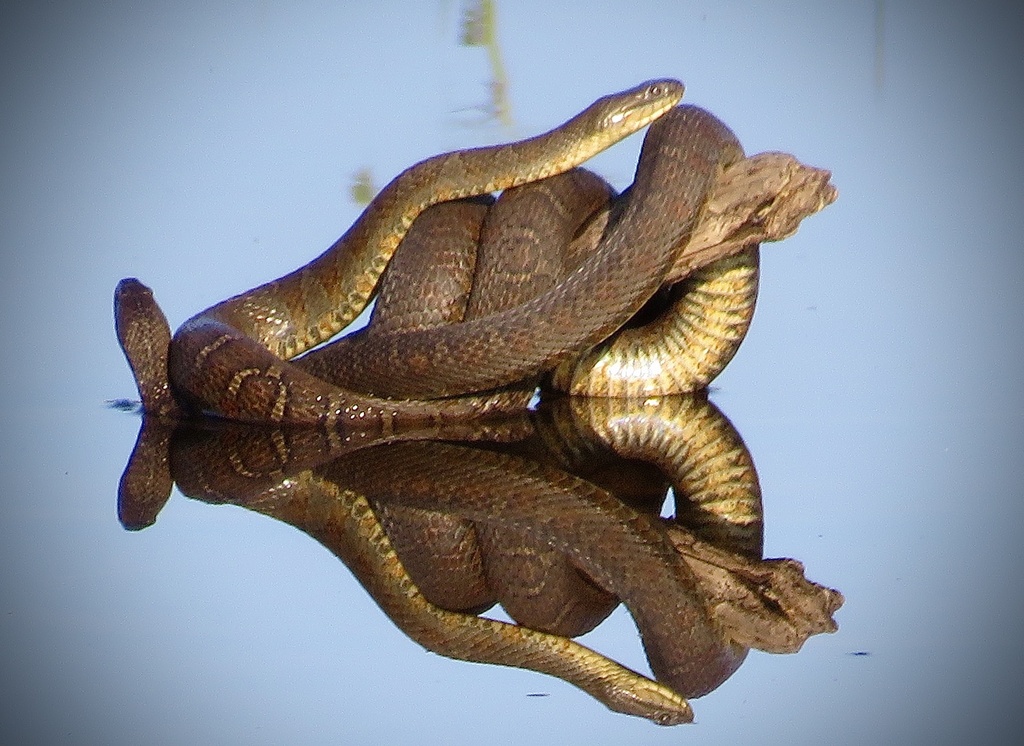
Common Watersnake - Photo by Tony Ward
View on iNaturalist
Mink Frog - 13 observations on iNaturalist in Central Algoma
The Mink Frog is a small greenish-brown frog that may not look like anything unusual, but it has one of the most unconventional ranges of any frog in North America. Its southern limit is actually farther north than any other frog on the continent, and its northern range limit stretches all the way to the southern shores of James Bay.
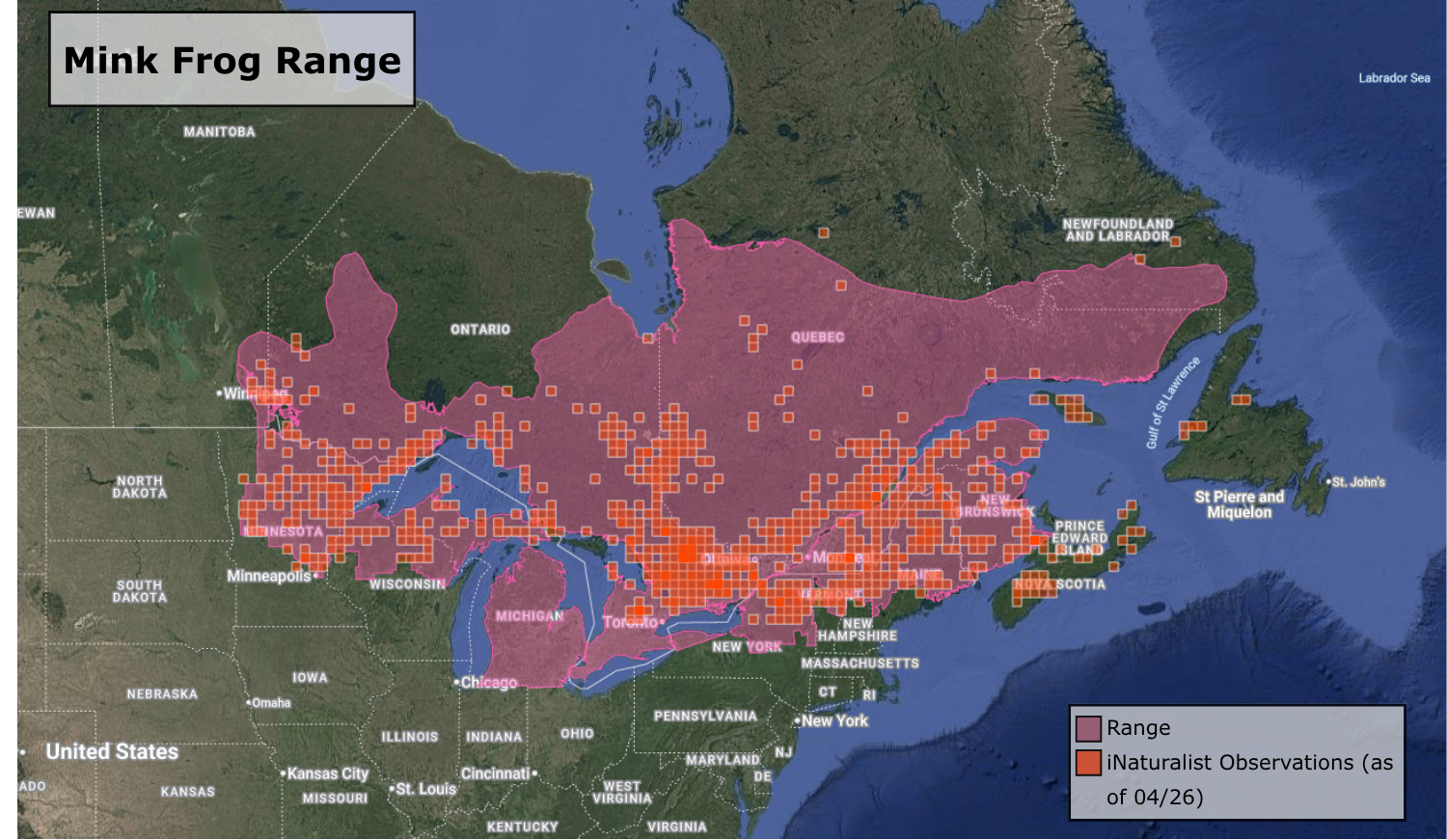
The range and verified observations of Mink Frogs.
Despite being considered to have a secure conservation status throughout its range in Ontario, Mink Frogs are surprisingly underreported. Across Ontario, there are fewer than 1,500 recorded observations, compared to over 31,000 for the much more familiar Green Frog.
This may be due to their preference for cold undisturbed lakes and bogs that are more prevalent to the north, but misidentification may also be a factor as they are commonly mistaken for similar species like the Green Frog (see below for how to tell the difference between them!).
Quick ID: Mink Frogs are a small, greenish-brown frog with irregular dark spots or mottling that run lengthwise on hind legs, typically have a yellowish belly, and often have no or faint ridges (dorsolateral folds) that run down the back. Green Frogs have distinctive bands on their hind legs, typically have a creamy-white belly, and have prominent dorsolateral folds.
Fun Fact: They are named for their scent, which is often compared to that of a mink. For those unfamiliar, it’s commonly described as similar to rotting onions. Their smell alone can be a key identifying feature…if you're brave enough!
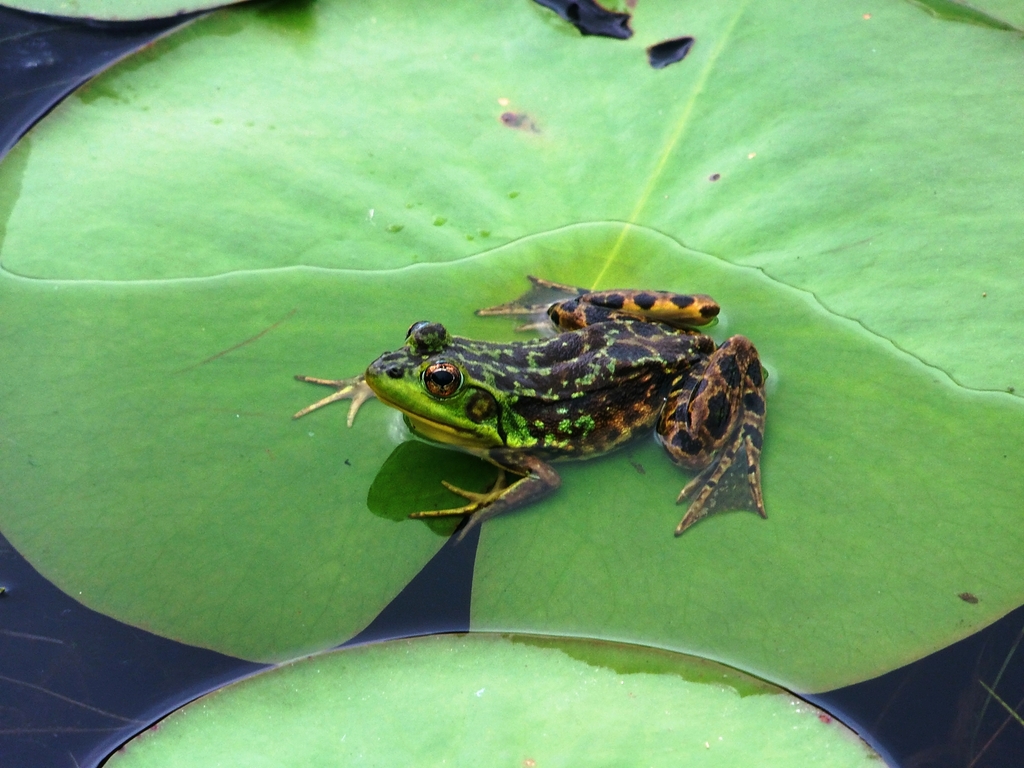
Mink Frog - Photo by Central Algoma Land Trust
View on iNaturalist
Spotted Salamander - 13 observations on iNaturalist in Central Algoma
The Spotted Salamander is a striking amphibian, black or dark grey with bright yellow spots along its back. They spend most of their lives underground, under rocks and logs, emerging primarily during spring breeding migrations to gather and lay eggs in temporary pools.
Although Spotted Salamanders are rarely observed in Central Algoma, that doesn’t necessarily mean there aren’t many here. Their cryptic lifestyle, slow dispersal, and dependence on specific breeding sites limit the locations where they can be found.
Here at our conservation centre, we’ve been fortunate to say that three of the fourteen observations were right outside our front steps!
Quick ID: A large, black salamander with two irregular rows of bright yellow spots running along its back.
Fun Fact: The eggs of Spotted Salamanders often appear green due to a symbiotic algae species living within the egg mass. The algae provide oxygen to the developing embryos while using the nitrogen-rich waste the embryos produce, a rare and fascinating example of mutualism in nature.
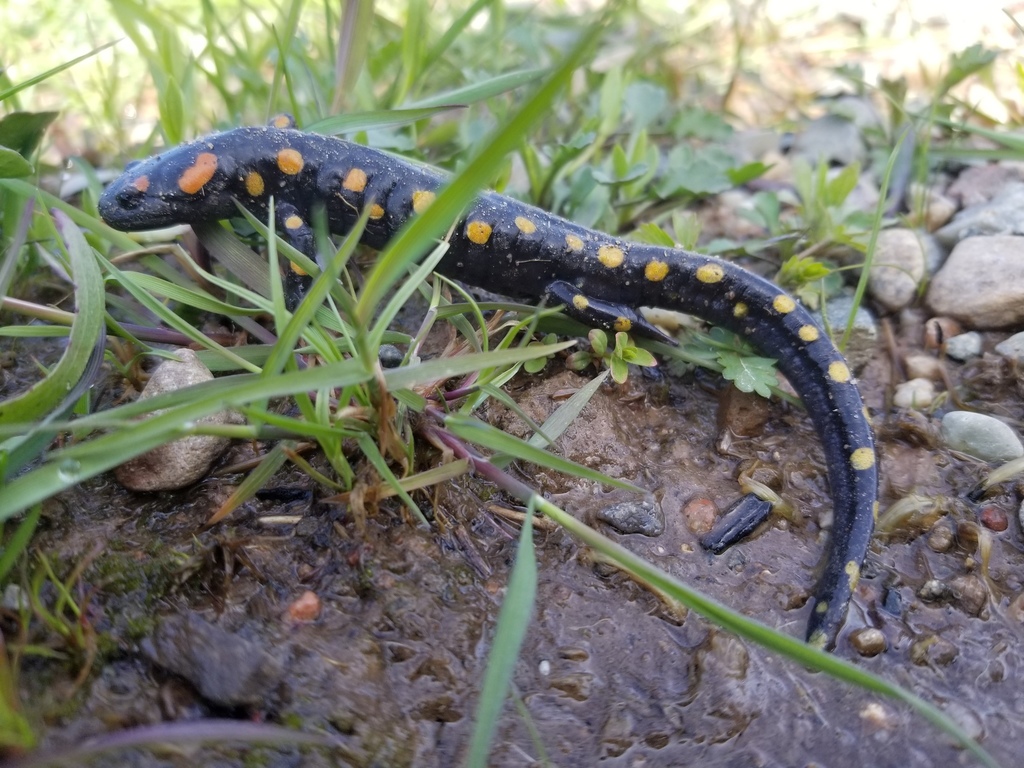
Spotted Salamander - Photo by Carter Dorscht
View on iNaturalist
Smooth Greensnake - 6 observations on iNaturalist in Central Algoma
The Smooth Greensnake is one of Ontario’s most striking reptiles, with a bright, almost neon green colour. Despite this, it often goes unnoticed, blending seamlessly into grasses and low vegetation.
The observations of Smooth Greensnakes in Central Algoma seem to reflect the fact they tend to exist in small, often isolated populations. Currently, all the observations of these brilliant snakes are clustered together at Fort St. Joseph, the most southern tip of St. Joseph Island.
But once again, just because more populations haven’t been recorded doesn't mean they don’t exist - be sure to keep your eyes peeled for this camouflage expert this herping season.
Quick ID: A slender, bright green snake with a smooth, glossy appearance and a pale yellow or white underside.
Not-So-Fun-Fact: Smooth Greensnakes are especially vulnerable to pesticides. Because they feed almost exclusively on insects, toxins can build up in their bodies through their prey, contributing to population declines in some areas.
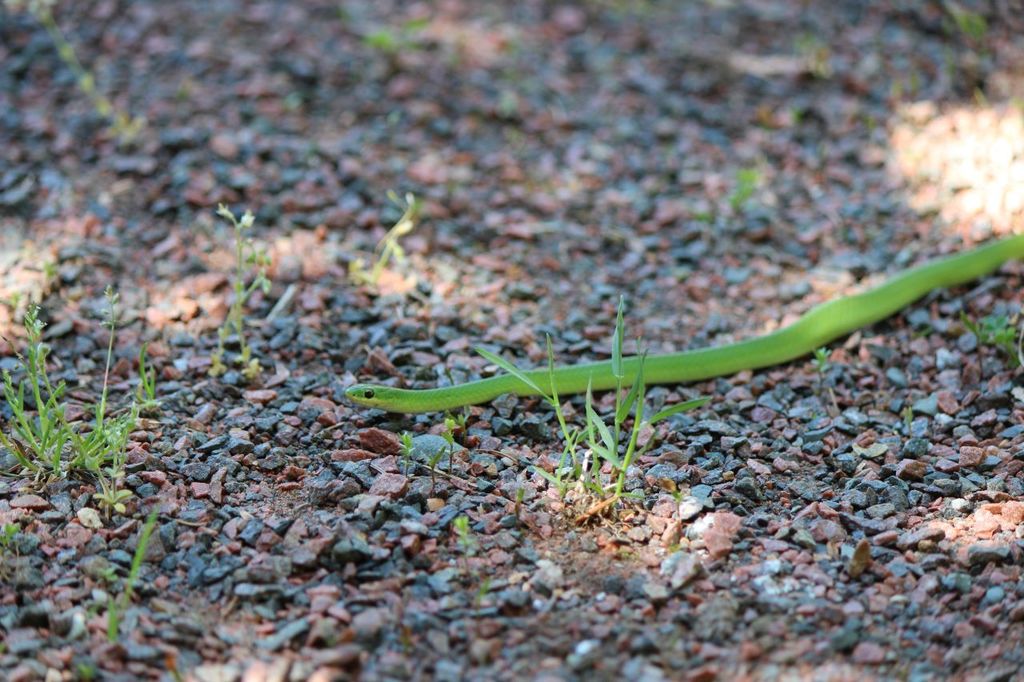
Smooth Greensnake - Photo by Fort St. Joseph National Historic Site / Lieu historique national du Fort-St. Joseph
View on iNaturalist
American Bullfrog - 5 observations on iNaturalist in Central Algoma
The American Bullfrog is Canada’s largest frog, with adults reaching up to 15 cm in length and weighing over a pound. Getting that big isn’t easy though, since all reptiles and amphibians are ecotherms (aka “cold-blooded”) they rely heavily on warm temperatures to fuel their growth.
In Central Algoma, an interesting pattern shows up on iNaturalist for American Bullfrog data: all six recorded observations of American Bullfrogs come from inland waterways, with none along the colder Lake Huron shoreline. Although we aren’t saying they can’t be found in Lake Huron, if you want to spot one yourself, you may have better luck in more sheltered waters.
Quick ID: A large frog ranging from olive-green to brown, often with dark spots or mottling on the back and legs. The belly is creamy white, sometimes with faint markings. Unlike Green Frogs, bullfrogs lack the prominent ridges (dorsolateral folds) that run down the back.
Fun Fact: Temperature actually plays a huge role in their development. In colder environments, tadpoles can take up to three years to transform, while in warmer areas, that same process may take just a few months.
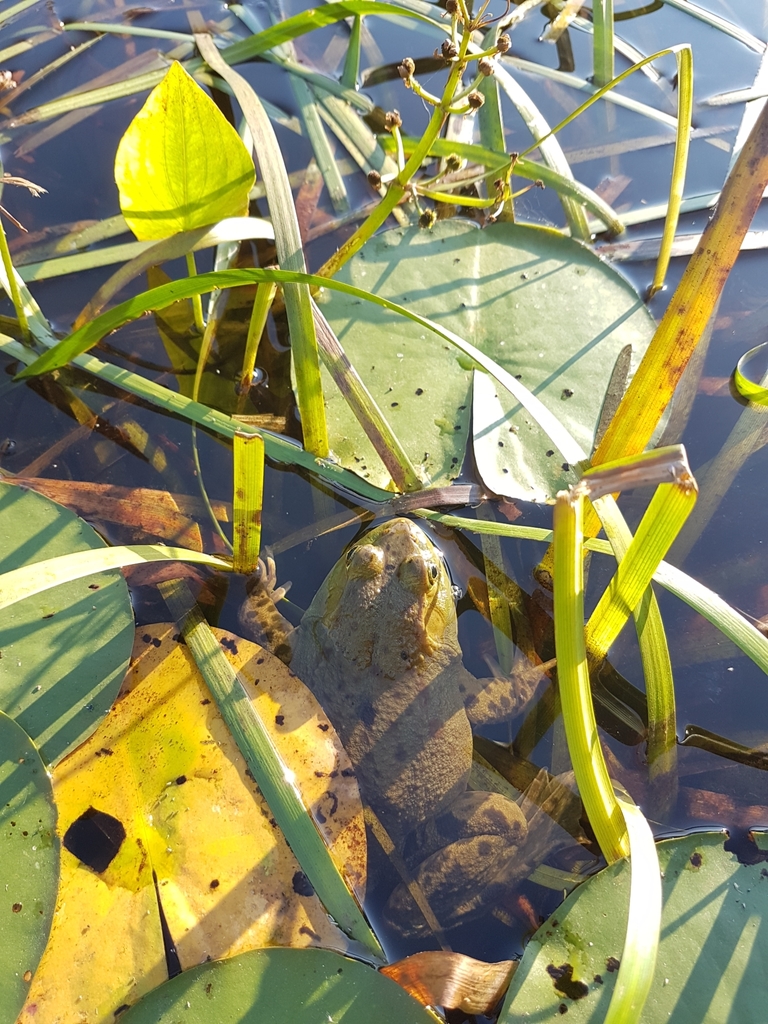
American Bullfrog - Photo by Rob Routledge
View on iNaturalist
Common Mudpuppy - 3 observations
The Mudpuppy is one of the most unusual amphibians, and one that many people never realize exists. Unlike most amphibians, Mudpuppies remain fully aquatic for their entire lives and retain their external gills into adulthood.
They are most often found in lakes and rivers, where they hide under rocks and submerged debris. Their secretive, underwater lifestyle makes them easy to overlook, and most sightings occur incidentally, often by anglers who are icefishing during the colder months when Mudpuppies are more active.
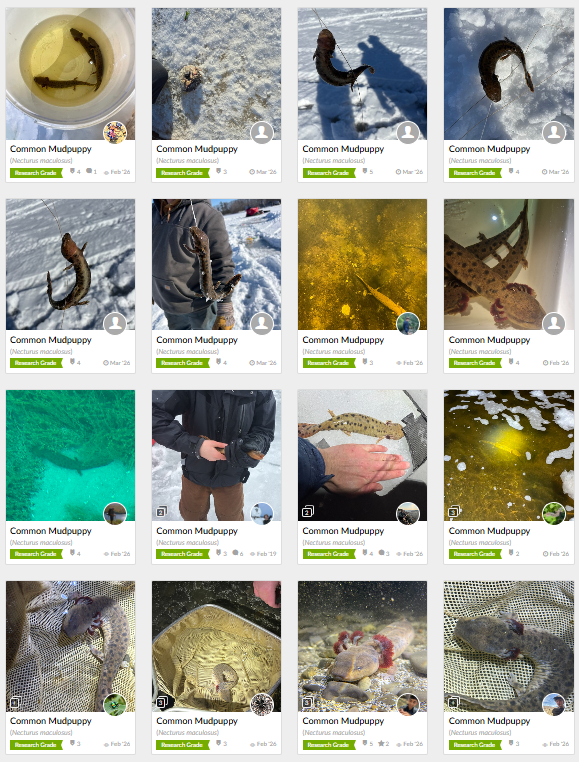
Example of the types of observations of Mudpuppies on iNaturalist.
While we can't be certain, we suspect that they are not as rare as the three observations elude them to be. If you have reeled in one of these remarkable salamanders, especially if you have photos, we would love to hear from you!
Quick ID: A large, grey-brown salamander with a flattened body, small eyes, and distinctive feathery red external gills behind the head.
Fun Fact: Mudpuppies are the largest salamander in Ontario. Adults can reach lengths up to 48cm, although they are typically found to be around 30cm in length.
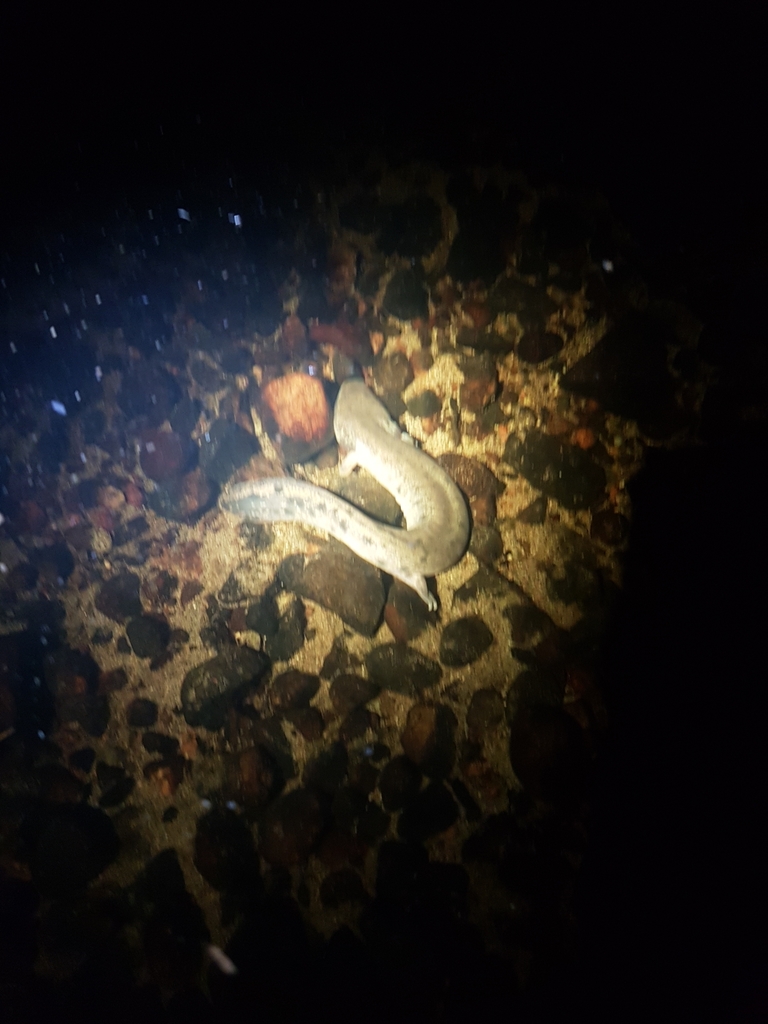
Mudpuppy - Photo by Rob Routledge
View on iNaturalist
Eastern Milksnake - 3 observations on iNaturalist in Central Algoma
The Eastern Milksnake is one of the most commonly misidentified snakes in Ontario. Its blotched pattern often leads people to confuse it with the Massasauga Rattlesnake, sadly often leading to unnecessary persecution.
In Central Algoma, observations of Eastern Milksnakes appear to drop off north of the Mackinaw Bridge and west of Iron Bridge, leaving most of the region almost empty of records. However, like many snakes, they’re secretive and tend to avoid people, so we are optimistic that they may be more common than they appear!
Quick ID: A grey or tan snake with bold reddish-brown blotches outlined in black along its back, and a distinct Y- or V-shaped marking on the head.
Fun Fact: When threatened, Milksnakes vibrate their tails in dry leaves to mimic a rattlesnake, an effective bluff, but one that unfortunately adds to their misidentification.
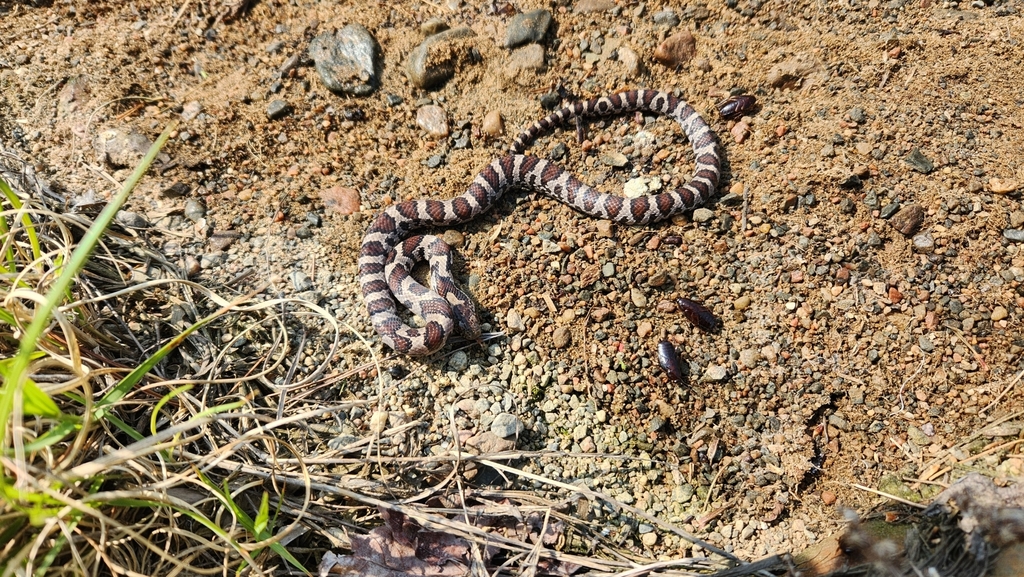
Eastern Milksnake - Photo by Jim Trottier
View on iNaturalist
Four-toed Salamander - 2 observations on iNaturalist in Central Algoma
The Four-toed Salamander is a small and secretive species that many people never encounter, despite its fairly wide range. True to its name, it is one of the few salamanders in Ontario with only four toes on its hind feet, a small detail that makes a big difference for identification.
This species depends on very specific habitat conditions. It prefers moist forests with sphagnum moss, where females lay their eggs in moss hummocks above shallow water, unlike most salamanders, which lay eggs directly in pools.
In Central Algoma, observations are very limited, but their small size and specialized breeding sites make them very difficult to detect, even when they are present. Unfortunately you are unlikely to casually happen across a Four Toed Salamander on any given day (we still have our fingers crossed though).
Quick ID: A tiny salamander with a reddish-brown back, white belly with black speckling, and a noticeably constricted tail base. No surprise, their hind feet have only four toes.
Fun Fact: Female Four-toed Salamanders will often guard their eggs until they hatch, an uncommon behavior among amphibians.
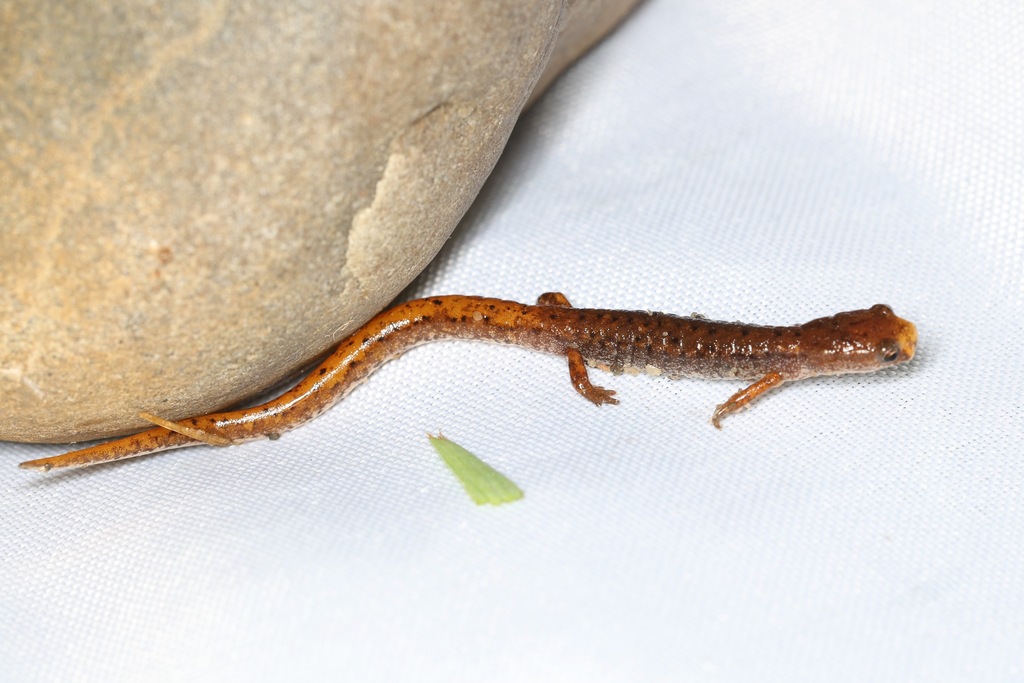
Four Toed Salamander - Photo by Cole Wolf
View on iNaturalist
Northern Map Turtle - 1 observation on iNaturalist in Central Algoma
The Northern Map Turtle gets its name from the intricate, map-like pattern on its shell, which resembles contour lines on a topographic map. It is one of Ontario’s more aquatic turtle species, spending most of its life in the water.
They’re typically found in large rivers and lakes, often basking on logs and rocks. The single observation in Central Algoma comes from the Lake Huron shoreline. This is an exciting sighting in a good habitat, but unfortunately one sighting doesn’t necessarily mean a population is on the way.
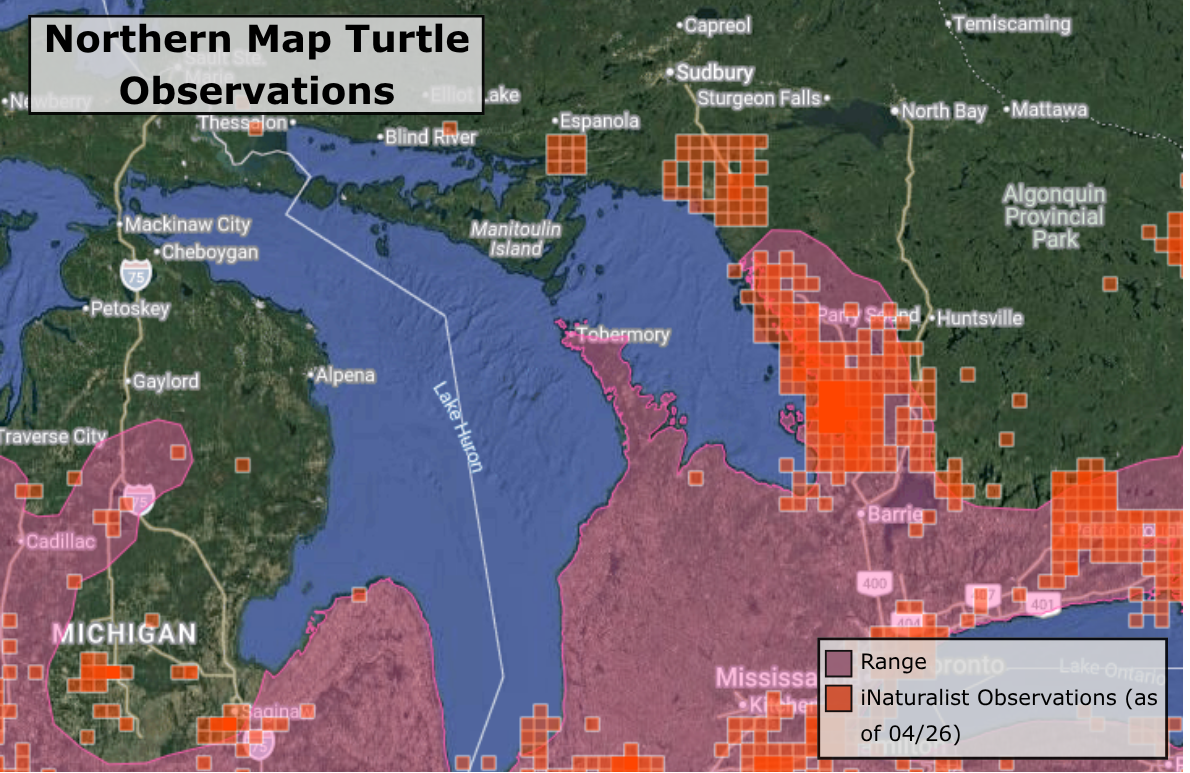
The range and observation of Northern Map Turtles.
Like many turtles, Map Turtles are slow to expand their range. With long lifespans, delayed maturity, and strong site fidelity, colonizing new areas can take some time. Still, that lone observation is an encouraging sign, even if it may take years, or decades, for a stable population to establish here.
Quick ID: A medium to large turtle with a dark shell covered in thin, yellow lines that resemble a map. Often seen basking in groups on logs.
Fun Fact: Female Map Turtles grow significantly larger than males (almost double) which leads to them having different diets. The female's larger head and more powerful jaw allow them to dine on mollusks and clams, whereas the smaller males are restricted to a diet of insects and small invertebrates.
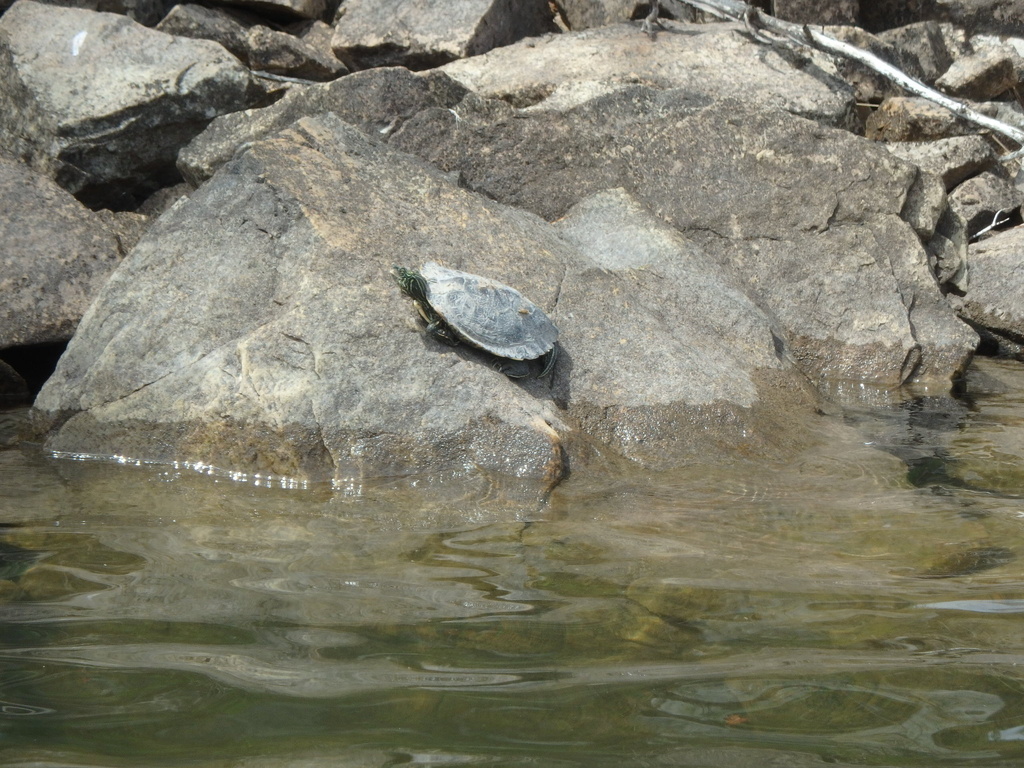
Northern Map Turtle - Photo by suegal
View on iNaturalist
Blanding’s Turtle - 0 observations on iNaturalist in Central Algoma
The Blanding’s Turtle is debatably one of the most recognizable turtles in Ontario, once you know what you’re looking for of course. Its bright yellow chin and throat, combined with a high-domed shell speckled with yellow, make it easy to identify, even from a distance.
During the breeding season, Blanding’s Turtles may travel considerable distances between wetland and upland habitats, a behavior that makes them especially vulnerable to road mortality.
Within our immediate focus area, there have been no recorded observations of Blanding’s Turtles. However, sightings to both the east and west suggest nearby populations. With increased awareness and effective conservation efforts, there is hope that these populations may one day become better connected.
Quick ID: A medium-sized turtle with a bright yellow chin and throat. Has a smooth, high-domed dark shell covered in yellow speckles.
Fun Fact: Blanding’s Turtles are exceptionally long-lived; some individuals can survive for over 70 years, but they take more than a decade to reach maturity, making population recovery very slow.
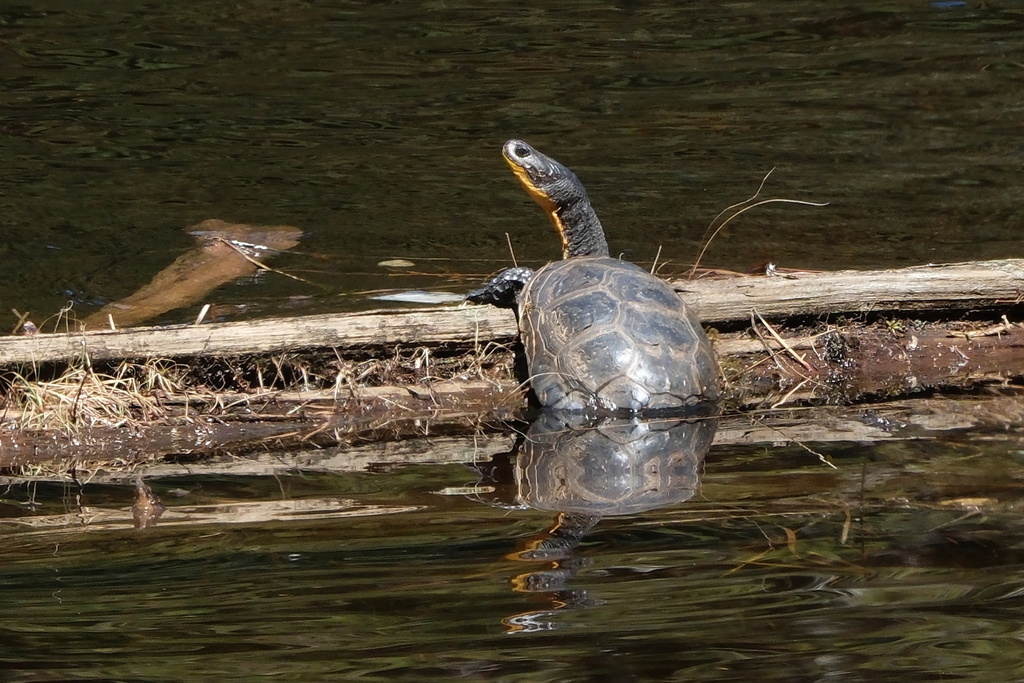
Blanding's Turtle - Photo by Sabine Atteln
View on iNaturalist
Common Ribbon Snake - 0 observations on iNaturalist in Central Algoma
The Common Ribbon Snake is a fast-moving, semi-aquatic snake known for its slender body and bold striping. Closely related to Garter Snakes, and often mistaken for them, it is typically found near water and is an excellent swimmer.
In Central Algoma, there are currently no verified observations, though there was a potential sighting on St. Jospeh Island within the last couple of years.
While they haven’t appeared on iNaturalist in the region yet, that doesn’t mean they won’t. Only time, and a few sharp-eyed observers, will tell if ribbon snakes, along with other species on this list, will become well known as a part of Central Algoma’s landscape.
Quick ID: A slender, black or dark brown snake with three bright yellow stripes running down its body and a long, thin tail. To tell it apart from a Garter Snake, look for a white spot in the corner of its eye, they are also typically more slender.
Fun Fact: Ribbon snakes rarely rely on constriction, instead, they quickly grab and swallow their prey alive.
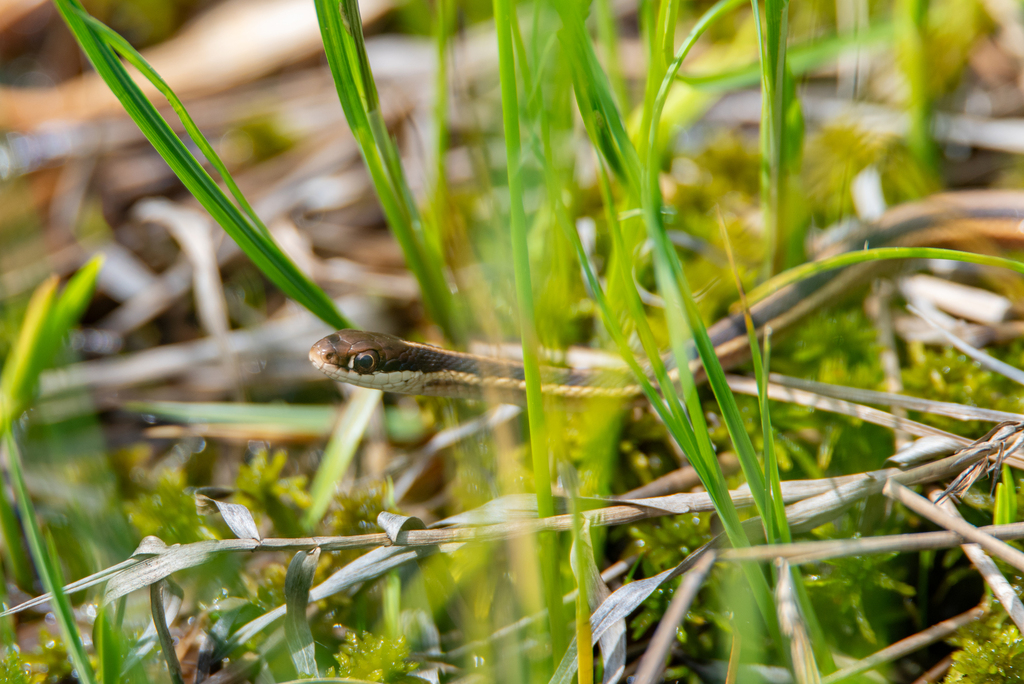
Common Ribbon Snake - Photo by Toby Rowland
View on iNaturalist
Other Honourable Mentions
Although no observations of them have been made of them in the Central Algoma region and they are unlikely to establish themselves here anytime soon, these are some of the species that could be featured in a future “part two” of this series, years down the line.
Eastern Massasauga
Despite being feared by many, the endangered Eastern Massasauga, a species of rattlesnake, is actually a shy and generally docile species. The closest known occurrences to Central Algoma are clusters of sightings around Mackinac Island and the Espanola area.
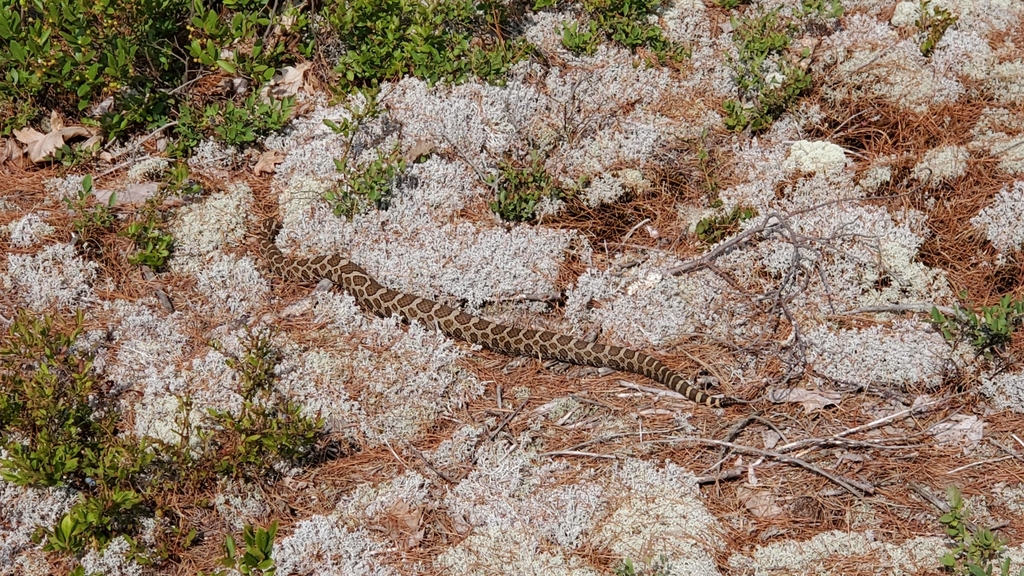
Eastern Massasauga - Photo by glennmac
View on iNaturalist
DeKay’s Brownsnake
The DeKay’s Brownsnake is a small species of snake that has yet to make its way to the Central Algoma region. Similarly to the Eastern Massasauga, the nearest sightings of this endearing slug eating snake are around Mackinaw City and just south of Espanola.
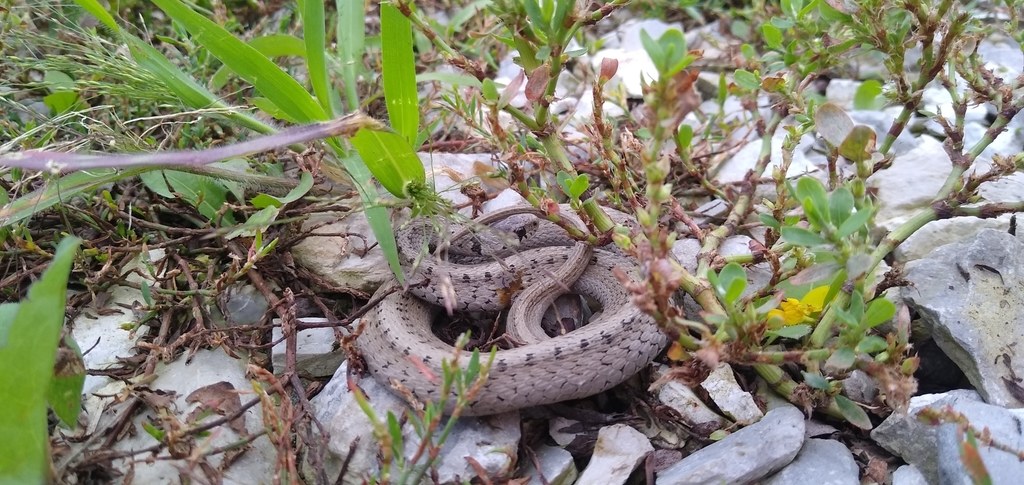
DeKay's Brownsnake - Photo by brunofamily
View on iNaturalist
Eastern Musk Turtle
This small and when threatened, smelly turtle, is also a known resident of the Espanola area.
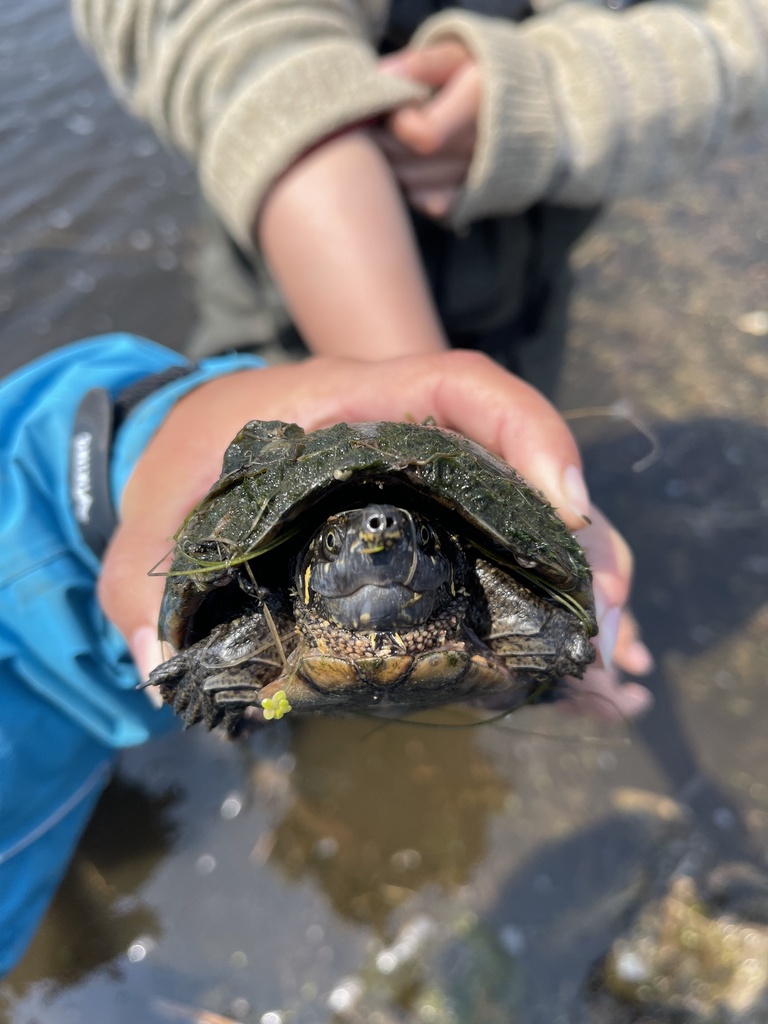
Eastern Musk Turtle - Photo by alex_mcg
View on iNaturalist
Cope’s Grey Treefrog
Only distinguishable from the more common Grey Treefrog by its DNA and call, this well camouflaged amphibian currently has been observed in Michigan and Manitoba, with no confirmed sightings in Ontario…yet.
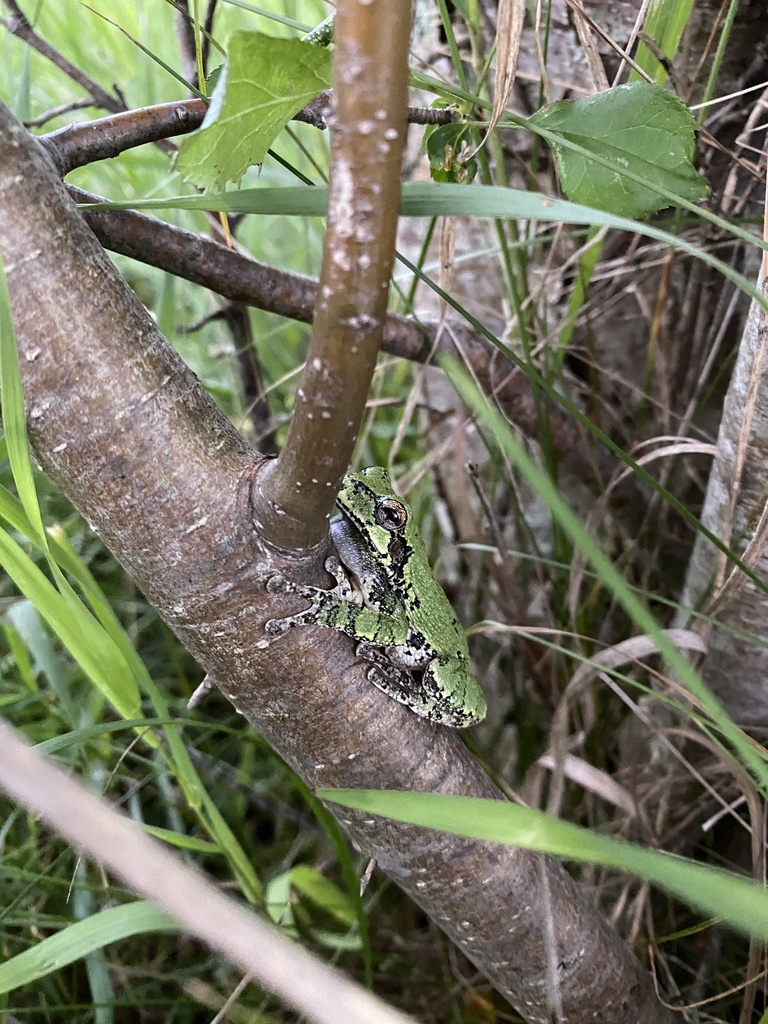
Cope’s Grey Treefrog - Photo by Austin Farley
View on iNaturalist
Reliance on temperature, cryptic behaviour, specific habitat needs, and excellent camouflage are just a few of the reasons herptiles can be so difficult to see, and even harder to document! But that’s also what makes each encounter feel so special when you’re lucky enough to spot one out in the wild.
If you’ve made it this far, I hope you can see the value in snapping a photo of any wildlife you come across, even if you’re not sure what it is. Especially in a time of environmental change and shifting climates, those small observations add up. They help us understand where species are, if they are moving, how they’re adapting, and how we can better protect them along the way.
This spring and summer, we’d love to hear about any encounters you have with any of the herptiles of Central Algoma. You can also share your sightings on iNaturalist, a community science platform where your observations can be identified by experts and most importantly, contribute to real data used by scientists tracking these shifting ranges.
Every photo counts. You never know when a simple snapshot might help tell a much bigger story!
The Central Algoma Land Trust depends on the generous support of our local community to carry out our work. Please consider making a donation to help advance conservation efforts across the Central Algoma region. Your contribution will help protect the natural spaces and wildlife that make this area so special.
